
The Love Stairway & The Missing Step

What re-reading my own book taught me about love, grief, and waiting.
In 2012, I co-wrote a book called The Love Stairway with a long-distance friend.
At the time, life felt relatively steady for both of us. Peaceful, even.
We wrote about God’s love from a season where “no news is good news” still felt true.
But not long after publishing the book, the waves came.

Death.
Illness.
Estrangement.
Moves.
Counseling.
Divorce.
Caregiving.
Covid.
Loss.
New Beginnings.
One day, when life felt especially heavy, I sat with my priest.
“Have you read your book?” he asked.
“Well, I did write it,” I replied with a slightly sarcastic chuckle.
He didn’t laugh.
Instead, he asked again:
“Have you read it?”
No, I hadn’t.
Have you ever listened to yourself on a recording or seen yourself in a video?
Doing so makes me cringe. I feel awkward and can hardly believe it’s my voice. I also tend to second guess what I share publicly.
“Sheesh! I should have said this or that. I should have done better.”
I’m my own biggest critic.
(Are you yours?)

Thank you, Fr. Jack - now in Heaven - for the homework assignment.
Re-reading The Love Stairway did help.
I had forgotten the subtitle of our book was How to Love Step by Step. We wanted to create an inspirational “how-to” book, and we shared these eight steps to best help to live out love:
Receiving
Forgiving
Accepting
Living Gratitude
Falling in Love with God
Serving
Loving Unconditionally
Forming Habits
Re-reading The Love Stairway also challenged me to dig deeper while continuing to move forward during rough seas.
Loving during peaceful seasons can feel natural. Easy.
But love during exhaustion?
During grief?
During disagreement?
During caregiving?
During uncertainty?
That kind of love costs something.
Australian conservationist and television personality Robert Irwin said in an interview:
“To love is to grieve.”
That statement has stayed with me, because it’s true.
We grieve because we have loved someone or something that is now gone or changed from what we once knew.
Change is hard.
Even good change can feel stressful.
And so I would add this:
To love is to also wait.
To change.
To grow.
And those things rarely happen in our preferred timing.
That’s okay, though.
God’s timing is always best anyway.

In fact, if I could add a ninth step to The Love Stairway, it would be this:
Waiting
Not passive waiting.
Not hopeless waiting.
But faithfully waiting.
Growing waiting.
Trusting waiting.
In today’s world of instant everything, waiting can feel excruciatingly uncomfortable.
People don’t want to wait.
But impatience can cause us to miss opportunities to be changed by love and to grow through love in profound ways.
There is importance in waiting if we allow ourselves to be still, present, and open.
Have you ever sat in a waiting room at a doctor’s office or hospital?
Waiting to be seen.
Waiting to be examined.
Waiting for results.
Waiting.
Everyone in that waiting room carries some form of baggage.
The weight may differ, but it all weighs something.
And in those waiting spaces, we have opportunities to help each other carry those burdens with kindness, grace, and love.
During a scan appointment for my dad, I stood in line to sign him in and collect the clipboard of paperwork to complete while he patiently waited in one of the chairs nearby.
As I waited in line, I noticed a woman in a wheelchair who had just finished her scan struggling with her caregiver to open the handicap doors to leave.

So, I stepped out of line and opened the doors for them.
They looked relieved.
It had clearly been a long day.
When I finally returned to my seat beside my dad, he leaned over and whispered in my ear:
“That was a good thing you just did for those ladies. Thank you for doing that.”
Leaning toward him, I whispered back:
“I was just doing what you would’ve done. I was doing what you taught me. Thank YOU.”
You see, opening the door for someone was one of the ways my dad served our Lord.
It was love in action.
He didn’t care about your age, your gender, or whether you were already holding the door yourself. He would still reach for the handle and let you enter before him.
It was his quiet way of saying:
“I see you.”
That day, my dad was no longer physically able to open the door for those women himself.
But seeing his love continue through someone else brought him joy and gratitude.
Maybe that’s one of the hidden gifts of waiting.
We begin to notice people more.
We begin to notice the needs around us, not just within us.
We begin to love more gently.
We begin to understand that God wants us to see others the way He sees them.
And slowly, we begin to understand that God sees us too.

“I see you.”
Maybe The Love Stairway was never meant to stop at eight steps.
Maybe love keeps stretching us upward through every season we never expected.
ESPECIALLY the unexpected seasons, when love can feel difficult.
So now I’d love to ask you:
What step would you add to The Love Stairway?
When do you find it most difficult to love?
And as you reflect on waiting, the other steps of The Love Stairway, and the challenges of loving through difficult seasons, can I ask you one more question?
If there were to be a sequel someday, what should it be called?
The Love Stairway: The Second Story
or
The Love Stairway: The Second Floor
I can’t wait to hear your thoughts.
Seeing you & joining you in the waiting…
Blessings,
Bonnie 🤍
✨ Did this post speak to your heart in some way?
I’d love to stay connected with you through The 4:13 Journal delivered straight to your inbox. It’s my free gift to you — a simple and meaningful space to reflect, reset, and remember the strength we have in Christ.
Feel free to share this post with a friend, too. 🤍
✨ Subscribe here:
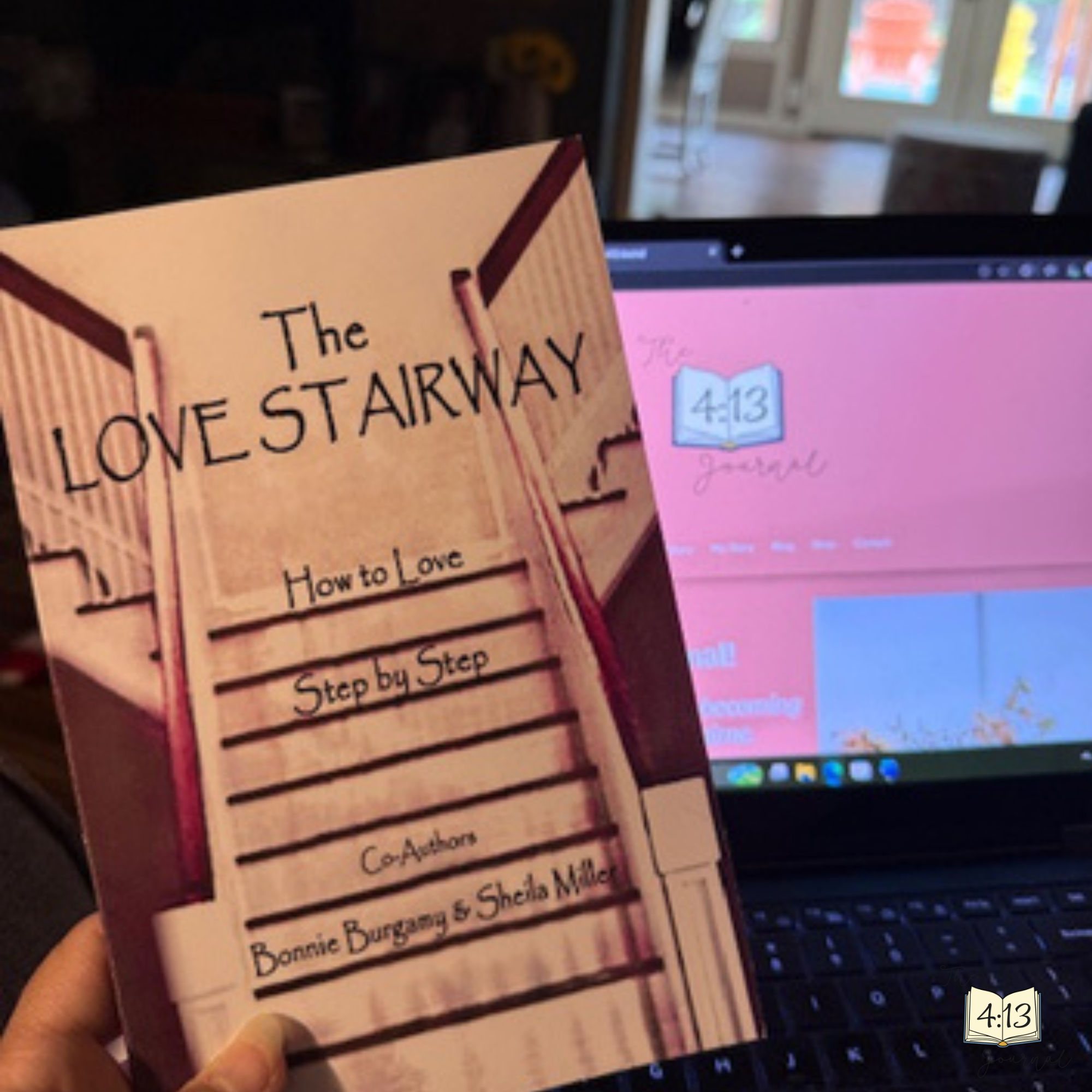
As I reflected on this post and revisited The Love Stairway, I realized I still have a small number of copies remaining. If this message resonated with you and you’d like a copy, I’d be honored to send one your way for the cost of shipping. Just send me a message below: